

Spinning machines for natural fibers in short series
And whether you’re a small business, a test lab or a university, with our line of commercial equipment you’ll have the flexibility to work with a wide variety of natural and synthetic fibers. Also the ability to perform tests with a few kilos or production runs of hundreds of kilos, all with the same machines. In addition to initial installation and training, we provide ongoing post-purchase support to our customers. And with the benefit of our experience, you will be able to quickly produce yarns, tops and wicks. Even if it is new to textile manufacturing. We also supply spare parts and accessories for both our own machines and other brands, and because our machines are designedand built in-house by us, we can make custom modifications to suit your application.
This commercial line allows to work with two types of fibers: long and short.

Long fiber machines
In this part we want to summarize in a simple way the steps necessary to transform the raw fibers into yarn according to the semi-combing process. To facilitate understanding, some optional processes (example: waxing, dyeing, vaporizing) have been deliberately ignored.
We start from the raw fibers after shearing:
• Washing
It is made to remove dirt, plant impurities, grease, and other contaminants from the raw material. For wool to be a useful textile fiber, it is essential thatall these foreign materials are removed. Crude fiber is very different from yarn or fabric. For this reason, the use of a normal washing machine, even with the softest program, produces caking. To avoid this problem, we customize an industrial vadora and dryer with the right speed and cycles. Our machine is equipped with many different programs for washing and drying different fibers.

• Opening
The fiber, washed and dried, enters the opener. This process makesit possible to entangle the fiber and prepare it for entry into the dehairing machine or card.
The fiber is put into the machine by means of a long conveyor and the material is slowly introduced by means of a solid inlet unit, while afast-moving cylinder with a fast-moving passage opens the fibers.
The open fibers are then transported through a clear plastic tube by means of a centrifugal fan, and the material is blown into a large ventilated bag that can be easily removed from the storage room.

• Dehairing
It is a mechanical operation by which the fiber of high textile value is separated from the bristles or primary fibers that produce the itching effect. This phase of the process is highly novel in the South American market. Our dehairing machine works mainly by using centrifugal force, transferring the fine fibers between cylinders that work at different speeds, while the heavier coarse fibers are preferentially expelled.
The fiber is fed from a conveyor to a 3-cylinder inlet unit that opens the fibers as they pass to the first separation cylinder.
In the central part the two high-speed cylinders separate the thick hairs from the finer fibers.
At the exit of the machine, a changing roller and a flying comb allow the collection of the desired fine fibers in a container.
At the bottom of the dehairing machine there is a second conveyor that collects all impurities and coarse fibers and deposits them in a waste collector at the front of the machine.

• Carding
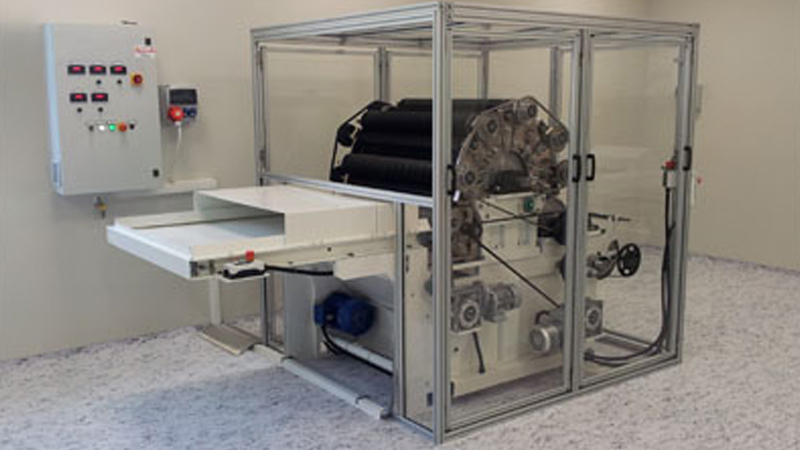
The carder is the heart of spinning milling. Once the washed fiber has been opened with the opener, the carder untangles the disorganized strands and aligns the individual fibers in a parallel arrangementto obtain the longer fibers to follow the spinning process.
Our carder achieves this by passing the fibers between differential movement cylinders covered with a carding garnish.
As the fiber moves through the machine, the carding process expels short fibers and begins to mix different types or colors of fibers. It has a long conveyor to feed the fiber at the inlet, after which the fiber is carded by the large drum and 5 working rollers.
At the exit, the changing roller and high-speed comb create a fiber net, which can be rolled to produce a Top or pulled through a twister to produce a wick. The carding machine is mounted on asingle steel support structure and is completely enclosed by an external safety cage.
• Stretcher per passage
The stretching, parallelization and homogenization of the mixture and its exit to the container boats occurs. The carder beginsthe process of aligning the fibers in a parallel arrangement, but stretching with pins completes this process. In addition, stretching combines different types of fiber or colors, creates a uniform ribbon to produce an even thread without thick and thin defects, and can be used to produce a tape of any desired thickness.
Stretching considerably influences the quality of the final product, as it is the final step in which the irregularities of the tape are corrected before spinning.
While a Stretcher per passage is traditionally used to straighten and parallelize cotton and other short fibers, a gill box peg stretcher is used to process wool, alpaca and other longs or shorts fibers

• Rolled
To transport and handle the beltin the best way, it is necessary to store it correctly without damaging the fibers and without compromising the regularity of the belt. To carry out this process, the textile industry uses a machinery called a can winder.
This tr machine supports the tape and deposits it inside cylindrical canisters on a regular basis.
To preserve the quality of the tape, this operation should be performed at the end of each step and then after the carding machine, after the stretcher and after the combing machine.
Our can winder is characterized by a very thin rotating head designed to work well with low cohesion fibers such as alpaca or mohair.
It has a simple but solid structure, and the electronic speed controller and interchangeable gearbox allow the winder to be attached directly to a carder or stretcher to synchronize the speed of the winder with the rate of tape production.

• Spinning
It is the process of adding twist to the stretched wick to create the thread. Several different yarn methods are used in industrial textile production, however, ring spinning remains the mostversatile method for spinning a wide range of fibre types with different fibre lengths. The input wick is first stretched to the correct weight by a series of rollers, then the torsion is introduced by the action of a weighted traveler who rotatesinto a ring around a spindle that is propelled at a higher speed. By putting together two or more strands of threads of a single layer, a stronger final thread is obtained. The wicks always twist together in the opposite direction to the one they were spun, creatinga balanced thread that does not roll on itself. After this step, depending on how it is marketed (in cones, skeins, or tangles), it will go to the corresponding machine.

• Cone Winder
The main purpose of this machine is to produce a compact set of yarn in a form suitable for use in subsequent operations. Cone-wound yarn allows the storage of a large amount of material in a small space and is usedwhen large quantities of the same batch of yarn are required, such as for weaving or machine weaving.
The central cone on which the thread is wound can be made of cardboard (economical and suitable for sale) or perforated plastic (more expensive but ideal fordyeing or vaporizing).
We can provide a compact cone winder. Depending on the productivity required we can offer machines with 1, 2, 4, 8 or more heads.
Our cone winders can be of two types: Equipped with a guide of móviles threads, slower and ideal for thicker threads. Or equipped with a slotted roller, very fast and suitable for fine and fine threads

• Ball Winder
Pack the yarn in a useful and compact form, usually for later retail sale. Tamb tanglesare some of the most recognizable types of yarn packaging. They are easy to work with and the ends can be pulled from the center or from the outside. The spherical shape helps to avoid tangles while working. In the market you can find differenttypes of balls: regular balls, donuts, cakes, balls with inner core.
We offer a perfect size heifer for small commercial producers and testing laboratories.
Depending on the productivity required we can offer machines with 2, 4, 10 or more heads. The machine is characterized by a fully automated cycle: Automatic opening and closing of the cores; beam movement; automatic cutting and clamping of the thread.

• Skein Winder
The skein is one of the ways in whichthe thread is put on sale and is the most common form used for the subsequent dyeing or hand painting of the thread. It is made by creating a continuous coil of thread that has been wound around a rotating frame of a known circumference, resulting in a skein of known length.
The skein is tied at two or more points of its circumference so that, when removed from the frame, it can be manipulated without the individual threads becoming entangled. Our woodwork also includes a machine winderwith many user-adjustable features. After setting the desired length of the skein, the machine will automatically wind the set amount of thread, slowing down to a stop at the end and automatically releasing the tension to allow the thread skeins to be easily removed from the frame. The user can configure the machine to simultaneously roll up to 9 skeins at a time. In addition, the guide of the moving wire can be varied to modify the thickness of the madejas that are produced according to the weight of the thread, and a spring tensioner provides the correct winding tension.

Short Fiber Machines
This line offers state-of-the-art, versatile and practical machines. Their compact size makes them ideal fororganizations that do not have a very large surface area. It is highly demanded by laboratories, universities and centers for textile research and innovation. In addition, they give the flexibility to work with many types of fibers, both natural andsynthetic fibers.


Fantasy thread machines
Times change, the industry moves forward, and we cannot be left behind. In fact, we believe we must be one step ahead. Therefore, we specialize in state-of-the-art equipment. We adopt thetechnology 4.0 to be able to offer cutting-edge, top quality and durable solutions. More than a machine, we want it to be part of the story that is about to be written.
Dedicated specifically to produce fancy yarns, for collection of volumetric yarns, for the production of special threads with hollow spindle, modern printing, lamination and color transfer processes, and humidifiers for industrial environments.
Our equipment has programmable automata, efficient control software, storage of work programs, machinery status diagnostic tools and above all a simple and intuitive graphical interface that will make the use of this equipment something simple and pleasant.
The result of this process is the most outstanding product: yarns of different character with a condition of excellence.
Our teams work to generate fantasy and luxury thread.
A fantasy thread is defined as a novel thread of appreciation out of the ordinary. These yarns are made with natural fibers, they can vary by numerous combinations of fibers, twists, folds, and colors among others, trying to make the most of all their individual and combined characteristics.


Measurement and quality control equipment
This commercial line is made up of electronic equipment that evaluates the quality of fibers from different origins for genetic improvement. It arose in response to the needs of the academic sector and the textile industry to acquire instruments and devices that help the characterization of fibers.
It is necessary to highlight the importance of the analysis, research, and evaluation of textile fibers in this industry. These processes are essential for the textile product to be competitive in quality and price at a regional and global level, in a market that constantly demands technological improvements.
The products we offer are electronic equipment of the highest technology and compact size. In addition, we offer research and evaluation services for textile fibers. And training so that your employees are always at the forefront in the knowledge of the new improvements of textile fibers.


